
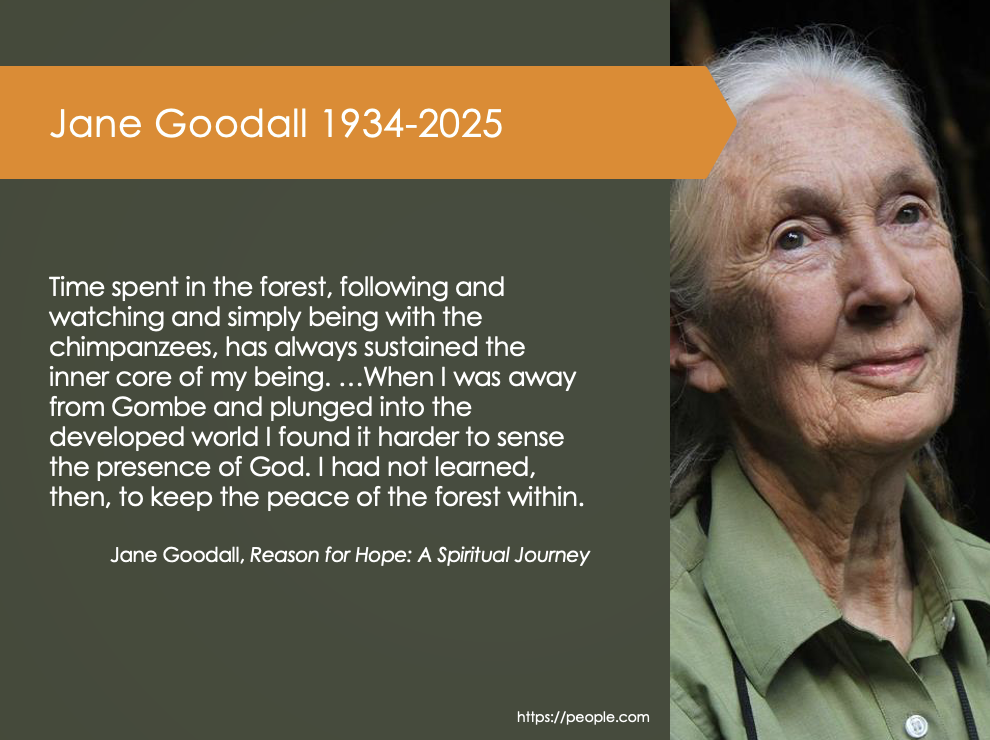
1. Responsive reading from a September congregational worship service in the park
 Written by Gail Powell
ICCT Steering Committee
and Pullen Memorial Baptist Church
Think of an experience you’ve had being in your garden or in nature, perhaps a sound you heard or something you saw that made you feel a sacred presence or a sense of awe. We have all had such an experience. Today, we encourage you to seek that sense of wonder and awe in nature. Knowing more about what is happening in nature during September can enhance those experiences.
Divine Energy
As our days grow shorter, our gardens, and woodlands are alive with a complex web of life. Trees share their trunk, crown, and roots with insects and birds, squirrels, lichen and fungi. Through photosynthesis, they share oxygen with you and me just as we share CO2 with them when we breathe.
Response: We honor the Divine energy that flows through all of nature with gratitude and love
Plants
Asters, goldenrod and perennial sunflowers have burst into bloom.
Hydrangeas, zinnias and salvias continue to bloom while black eyed Susans have faded leaving seeds for the finches.
Berries ripening on dogwoods and purple beauty berrys welcome migrating birds.
Walnuts, acorns, and pinecones hang from trees offering future nourishment for mammals and birds.
We honor the Divine energy that flows through all of nature with gratitude and love
Insects and spiders
An occasional monarch may pass by as they migrate south.
Butterflies abound, pollinating flowers by day,
Moths are pollinating by night.
Caterpillars pupate in preparation for winter
Praying mantises lay their egg masses to overwinter til spring.
Spiderwebs glisten in the fall sunshine.
As the daytime sounds of cicadas wane, the evening chorus of crickets and katydids create a night time din.
We honor the Divine energy that flows through all of nature with gratitude and love
Birds
Now that breeding season has ended, morning bird songs grow dimmer.
Tanager, grosbeak, warbler, and hawk migrations begin.
Cardinals, wrens, titmice, chickadees remain to winter with us.
We honor the Divine energy that flows through all of nature with gratitude and love
Reptiles and amphibians
Eggs of lizards and snakes are hatching, including copperheads.
Most turtle nests have already hatched.
Marbled salamanders are migrating to breeding sites.
Tree frogs share their evening chorus
We honor the Divine energy that flows through all of nature with gratitude and love
Mammals
Many mammals are foraging to build their fat reserves for winter.
Squirrels and chipmunks gather and bury acorns and nuts.
Deer begin to develop a thicker coat. Fawns lose their spots. Bucks shed their velvet
Let us open our hearts to the natural world.
We honor the Divine energy that flows through all of nature with gratitude and love
2. ICCT 2025 Convention Keynote Gives Us Hope

by Joe Rabenstine
ICCT Vice President
In her keynote address on September 20, 2025, Rev. Dr. Jerusha Matsen Neal, associate professor of homiletics at Duke Divinity, reminded 110 of us at the Convention that our reasons for hope, “grounded hope”, are part of an “old, old story.” The words of prophets and sacred scripture writers from many faith traditions have told of problems afflicting us and our world, and have shown us how to maintain hope. With eloquence, passion, anecdotes from cultures around the world, and engaging rhetoric Jerusha showed us a plan to grasp hope “in the face of ecological loss” today.
She said that before we get to optimism – and let’s get there – we have to look this crisis in the face, particularly as people of faith. Jeremiah 4:24 says, “I have seen the earth and here, it is wildness and waste, and I look to the heavens – and their light is gone.”
Her talk began with impediments to real hope and progress. Thinking that hope is abundant is cheap hope. There’s denial about what we’re really facing. And having so much confidence in our ability to fix, save, and go into communities and tell them what to do is like playing at divinity. There’s also succumbing to despair.
Her colleague, Biblical scholar and Professor Ellen Davis, and Jerusha taught a class to Duke Divinity students, many of whom were working and preaching in North Carolina congregations. They looked deeply into the many reasons it’s a challenge to preach and teach climate change in their settings – including plain old fear. “What does one say in the face of the unthinkable?”
Jerusha demonstrated that the many reasons for avoiding this topic can be faced and preaching “Creation Care from the breadth and depth of your sacred text” is welcome and effective. There are so many texts that help us grapple with questions…like where is God during this exploitation, displacement and loss? Can God be trusted? What does faithfulness look like? And does human action matter?
 For those preaching, teaching, and practicing Creation Care, Jerusha provided six steps, “takeaways”, to enable us to move successfully on a hopeful path forward.
1. Re-remember the “Old, Old Story.” Our sacred texts give us story after story of hope
2. Make justice connections – Social justice and environmental justice go hand in hand
3. Honor everyday resistance – Refugia, relationships and resistance do prevail
4. Draw on spiritual disciplines – Table fellowship, communal discernment, sacraments and our unique cultural and spiritual practices lift us up
5. Renounce false optimism … reject despair … look honestly at today and toward tomorrow. “Hope is a discipline.”
6. Recommit to community – reflect and work together for we are each other’s hope
“There is beauty in this brutal, damaged world of ours … beauty that is uniquely ours and beauty that we have received with grace from others.” Arundhati Roy
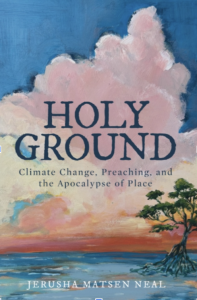
Look for Jerusha’s Powerpoint presentation in a subsequent newsletter. See the cover page of her new book here.
4. Two very different events with Partners for Environmental Justice on the same day, Oct 25

There are two events with Partners for Environmental Justice in Raleigh on the same day. One is hands-on native planting in Dix Park; the other is learning about and healing our racialized histories in our community and their impact on the environment, held at Walnut Creek Wetlands Center.
ICCT is excited to share these events. One of our three operating principles is to focus on environmental justice. Working with Partners for Environmental Justice (PEJ) is a way to do that right here in the Triangle.
Your first PEJ option is:
Healing Our Histories: An Analysis of Environmental Racism in Raleigh
Organized by the Covenant Christian Church, Walnut Creek Wetland Center, 950 Peterson Street Raleigh, NC 27610
Saturday, October 25 · 9am – 2pm
You are invited to join members of the wider Raleigh community to learn about the racialized history of our community and its impact on the environment. The event will include lunch, conversation, and time on the creek.
You will hear from historian and activist Carmen Cauthen, author of Historic Black Neighborhoods of Raleigh, pastor and author Rev. Greg Jarrell, author of Our Trespasses: White Churches and the Taking of American Neighborhoods, and the staff of the Walnut Creek Wetland Center.
We will organize for action around the current issues facing our area, as the population grows and development increases, and we will build relationships that will connect those already organizing in Raleigh.
Your second PEJ option is Green Stormwater native planting at Dix Park on Saturday October 25th!

5. Do you love birds? Here’s how you and your faith community can protect them
 Submitted by Bobbi Mullins
Co-leader, ICCT Advocacy Team
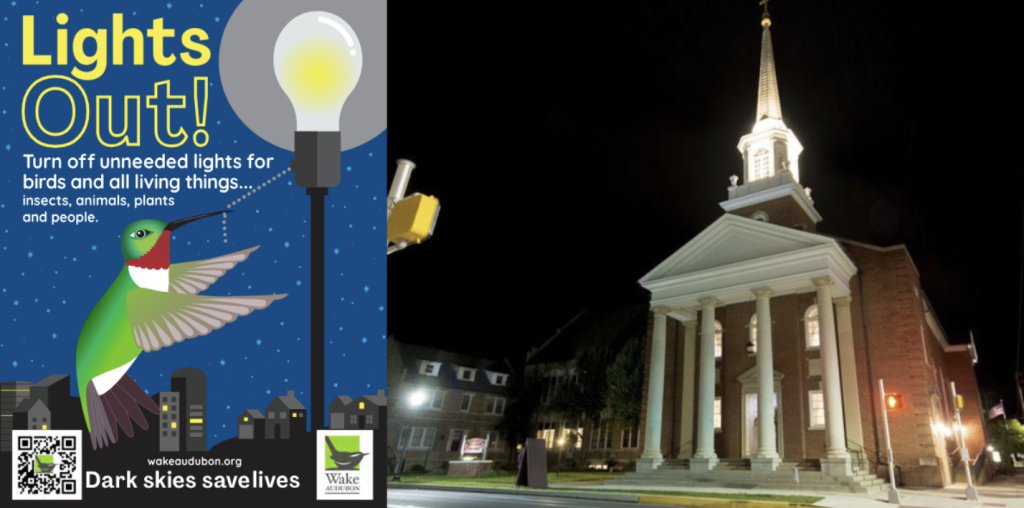
Audubon North Carolina, through their Lights Out initiative, is working with cities, individuals, businesses, and churches to become more bird-friendly by turning off unneeded lights at night during the fall and spring migration periods.
Lights Out NC occurs every fall from September 10 – November 30 and again each spring from March 15 – May 31. Turn unnecessary lights out from 11pm to 6am.
Chapel Hill, Durham, Raleigh, and Cary have developed Lights Out policies. Raleigh, for example, turns off all non-essential lights in City facilities during the migration periods. This simple practice saves birds from disorientation and deadly collisions while reducing energy usage, saving money, and protecting the environment. Now, many buildings are extending the policy year-round.
Your faith community can participate as well. It’s as easy as flipping a switch. Ask your faith leaders to turn off steeple lights and/or other non-essential outdoor lighting, especially upward facing lights, between 11pm and 6am. Lights Out Wake advocates for all homeowners to take simple steps at their homes to create a better nighttime environment for birds, wildlife, insects, and people, too. Let’s all pitch in together and care for our human and non-human neighbors!
6. Creation care book discussion

All are welcome to join the online discussion led by Rev. Tracy Clayton about On the Swamp: Fighting for Indigenous Environmental Justice by Ryan E. Emanuel on Monday, October 27 at 10:30 AM.
Dr. Emanuel is a Lumbee scientist, community-engaged scholar, and author from North Carolina. He is a tenured faculty member at Duke University who specializes in the science of water and ecosystems as well as policies on environmental justice and Indigenous Rights.
Book Discussions are on Zoom on the third Mondays at 10:30 a.m. If you’re not already on Tracy’s list and would like to receive the Zoom link, contact her at tclayton@nccumc.org. Regis
https://us02web.zoom.us/
Note: In 2020 Dr. Emanuel led an engaging webinar for ICCT on Environmental Racial Justice in the Age of Climate Change. You can watch it here. Scroll to the 18 minute point to go directly to his presentation.