

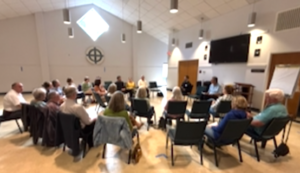
On a beautiful Saturday afternoon in October, 22 ICCT liaisons gathered with a group of ICCT board members at the Church of the Nativity in Raleigh to get acquainted with each other and learn more about the effective and important role that liaisons play in their faith communities.
Liaisons are critical to the promotion of two-way communication between their faith communities and ICCT. You can find a list of liaisons and their faith communities here. If you’re interested in serving as a liaison to your faith community, you can sign up at this link.
At the gathering, Liaisons shared that it was comforting to be part of an umbrella organization like ICCT. At times it can be discouraging to advocate for creation care in their own faith communities and not feel fully supported by their membership or clergy. ICCT provides a vital support as well as a variety of events in which members of their faith communities can participate.
—Neil Pedersen
The Summary of the ICCT Liaison Meeting
October 24, 2026, 1-3 pm
ICCT Liaisons representing 22 congregations gathered on October 24 at the Church of the Nativity to meet with each other and ICCT board members, hear from a panel of experienced liaisons, and have their questions answered about the liaison role.
Welcoming comments were followed by an opening reflection that reminded us that “while not all are guilty…all are responsible”, an attitude and prayer that resonated with everyone gathered there committed to caring for Creation. A series of ‘ice breakers’ invited the participants to introduce themselves to each other, share what they cared to protect the most, confess their own ‘eco-sin’, identify one of their congregation’s successes and one thing they hoped to strengthen or begin to promote caring for God’s creation.
The panel presentation provided meaningful insights into the efforts of three congregations – Binkley Baptist (Chapel Hill), Storied Church UMC (Mebane), and Epworth UMC (Durham).
With wide-ranging experiences at Binkley Baptist, Charles Coble provided lessons from a well-developed program that included:
- activities with the “triple stream” of recycling, composting, and waste reduction (inspired by Nativity’s Zero Waste Church program)
- grant funded solar panels and energy audits
- outreach efforts with clean-up activities in conjunction with the Haw River Assembly that got their families engaged outdoors
- getting their ministers on board with preaching on Creation Care
- dealing with the reality many members down-sizing their homes and arranging to give away items for others to reuse
- addressing the need for succession planning as existing team members retire.
J.P. Powers, from Epworth UMC, focused on what an individual can do, the importance of playing to your own strengths (“know thyself”), and of letting others do the same. His ability to consume and consolidate information from lots of sources and his analytic capabilities gave Epworth UMC a data-driven approach to track and monitor their own carbon emissions against their stated goals. His newsletter provided awareness on topics and issues and all events related to their mission, an awareness available for all. But he acknowledged the impact of this information ultimately depends on the engagement of individuals that can vary widely, from leading, to being interested, even to apathy. Special recycling drives at Epworth were successful along with a well-attended lunch and Q&A to clarify proper recycling and composting techniques.
J.P.’s presentation provided the opportunity to highlight the value that ICCT helps its members feel they are not alone, and it raised the suggestion that ICCT might provide a central repository of resources from and for its members.
Denise Nepveux’s presentation (Denise was ill and unable to attend so Neil Pedersen made her presentation for her) highlighted the variety of activities that are possible even in a small congregation like the Storied Church with passionate leadership including:
- We nearly eliminated disposables from our coffee hour and potlucks (at least those that we hold onsite) by purchasing used flatware and dishes.
- We engage in Riverwatch – a community science program in which we step into a local creek 4 times a year and evaluate its health.
- Our book club, which meets weekly, is devoting this fall’s meetings to working through Braiding Sweetgrass.
- 3 or 4 times a year, we replace the Sunday service with a hike and brunch. This is not a new practice for Storied Church, but now we are beginning to add nature awareness activities to the hikes to help people slow down and connect with nature and one another. One member mentioned that this slower approach meant that she could now participate without worrying about falling behind.
- We are partnering with a local elementary school to expand its natural play and learning spaces. This fall we helped maintain their vegetable garden and we planted a pollinator garden in the school’s main courtyard.
- We hold intermittent swaps after church to encourage sharing and recirculating rather than buying new
- We devoted 4 Sundays in September to the Season of Creation, including one nature exploration hike and three services with lay-led sermons. Resources shared by ICCT were very helpful for these services.
“I’ll admit that until recently most of the push for creation care has come from me, and most of the legwork has been done by me and a couple other people. But with the book group reading Braiding Sweetgrass, the creation care services we held in September, and a number of people pitching in to build the garden at EM Yoder Elementary, I I feel a shift such that creation care is becoming more central to who we are as a congregation.”
The final segment of the meeting was a Q&A that provided discussions on:
- how to get started (energy audits, free from various providers including the Council of Churches: https://ejc.ncchurches.org/climate-energy/)
- how to impact the broader community (through involvement with groups like OneWake)
- how to start and sustain a Creation Care ministry.
This last question evoked many responses, including:
- the need for patience and persistence
- promoting distributed leadership
- the use of small, committed teams
- popular programs in nature like trail and waterway cleanup activities
- develop an annual report – collect the data, measure, and report (e.g., pounds of cleanup collected, amount of compost generated)
- create a succession plan for retiring leadership
- importance of individual asks and relationships
- focus on tasks rather than titles
- engage children as a strategy to engage adults
The meeting wrapped up with expressions of gratitude to our hosts, Carl and Emily Sigel, at the Church of the Nativity. Plans for on-line and/or in-person ICCT liaison meetings will be announced for next year as they are developed.


