
What Keeps Us Apart?
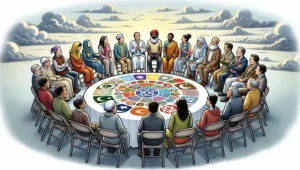
Two or three years ago, I was asked to represent the Christian perspective at an Interfaith Creation Care of the Triangle panel presentation. Alongside me were presenters representing Judaism, Islam and Buddhism. We were all asked to share some from our tradition’s sacred texts, as well as our own perspective as to why creation care matters.
I presented first, then sat and listened to the other panel members as they read from their own sacred texts and presented their own personal reasons for caring for this planet we share.
When I was younger and beginning to truly learn about my own religion and develop my own faith, I remember being taught how different all of our beliefs were, and that these differences set us apart, sometimes even put us in opposition to one another.
Yet as I sat and listened to my fellow panelists, I couldn’t help but notice how alike we all were. We all wanted the same things- a clean, safe home for ourselves, our loved ones, and our neighbors- and we all lamented the same things- that this world we inhabit is not as it should be, that clean air and water and soil are becoming luxuries while the most vulnerable continue to suffer. What really struck me was how similar our sacred texts were. I think any of those texts that were read that day could have been read in any Christian church I’ve ever been a part of, and nobody would have batted an eye as long as we didn’t say, “Oh, by the way, this actually comes from…”
Friends, I believe you want the same things and lament the same things that my fellow panelists and I talked about that day. It is a huge undertaking, to make this world the kind of place that we all know it should be. It is such a vast undertaking that I am often tempted to despair; how can we overcome such insurmountable obstacles?
That day, listening to my fellow panelists share their faith and their vision, reassured me that we can, in fact, bring about a better tomorrow. We must discard the notion that we are set apart from one another, that we must be in opposition to one another. Instead of letting our differences keep us from one another, let us celebrate both our differences and similarities, so that we may work together, hand in hand.
It turns out we actually have a lot in common, including this earth, our shared home.
Jarrod S. Davis
Elder, the United Methodist Church
Contents
(1) ICCT to Become 501(c)(3)
A select group of ICCT Board members met in person recently to sign the paperwork and submit the application for ICCT to be recognized as a 501(c)(3)…
(2) Advocacy Team Making Our Voices Heard
On Feb. 4th, Advocacy Team member, Amy Marschall, made comments on behalf of ICCT at the NC Utilities Commission (NCUC) hearing on Duke Energy’s proposed Carbon Plan for 2026 that’s woefully short on renewable energy…
(3)Preparing to Meet With Our Elected Officials: A Webinar
In this ICCT Webinar, Preparing to Meet With Our Elected Representatives, Susannah Tuttle of the NC Council of Churches’ Eco-Justice Connection will review step-by-step guidance and sample scripts for scheduling an introductory meeting with our elected representatives. Join us on Wednesday, March 25, 6:00-7:00pm. Follow link for more information…
(4) A Word from Our Liaison Coordinator
Neil Pederson, ICCT Board Member and Liaison Coordinator, shares his efforts to build up and improve our Liaison network…
(5) Other Happenings
A list of events, resources and “other happenings” around us that you might be interested in.
(1) Interfaith Creation Care of the Triangle Takes Major Step Toward 501(c)(3) Status
Triangle Area, NC — Interfaith Creation Care of the Triangle (ICCT) has officially begun the formal process of becoming a federally recognized 501(c)(3) public charity, marking a significant milestone in the organization’s growth and mission.
In a historic gathering of the organization’s officers, President Lynn Lyle, Secretary Susan Kane, Vice President Joe Rabenstine, and Treasurer Michelle Hunter met in person to sign a legal organizing document, obtain an Employer Identification Number (EIN), and electronically file IRS Form 1023-EZ — the required application for recognition as a public charity under Section 501(c)(3) of the Internal Revenue Code.
“It’s very exciting to have taken this big step forward in the life of our organization,” said Treasurer Michelle Hunter, who coordinated the filing process. Special recognition was given to Boyd Rogers for his guidance in navigating the application process.
ICCT brings together faith communities across the Triangle region united around a shared calling to care for the earth. Official 501(c)(3) recognition will allow the organization to expand its reach, pursue grant funding, and offer donors the benefit of tax-deductible contributions in support of its work.
Approval by the IRS is expected to follow in the coming weeks or months. Once granted, ICCT will be fully positioned to deepen its programming and partnerships across the region’s diverse faith landscape.
For more information about Interfaith Creation Care of the Triangle, visit interfaithcreationcare.org.
Contact: Jarrod Davis, Communications — Interfaith Creation Care of the Triangle
(2) Advocacy Team Making Our Voices Heard
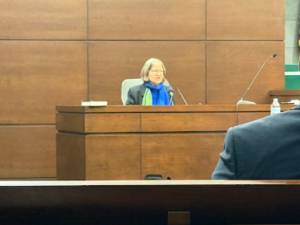
Amy Marschall Testified on Duke Energy’s Woefully Short Carbon Plan
You Can Give Your Comments Online
Did you know that as a part of the ICCT network, you are also part of our collective voice when we sign onto organizational letters and submit public comments? These letters and comments have the weight of over 600 members and 115 faith communities in the Triangle behind them!
We are proud to share with you a few recent ICCT actions where our members spoke (or wrote) as representatives of ICCT. We are also providing opportunities where you can multiply the impact by taking individual actions on these issues as well.
ICCT at the NC Utilities Commission Hearing
On Feb. 4th, Advocacy Team member, Amy Marschall, made comments on behalf of ICCT at the NC Utilities Commission (NCUC) hearing on Duke Energy’s proposed Carbon Plan for 2026 that’s woefully short on renewable energy. Here is a copy of her testimony that is now in the record. You can also read a WUNC article covering the hearing.
Submit Your Comments Online to NCUC
You are welcome to submit your own public comments to the NCUC as well. Citizens’ Climate Lobby has created an excellent document with resources to help you craft the best possible comment, including a webinar, talking points, a link to the comment portal, and more. We recommend sending in comments by March 18th, the date of the last public hearing.
ICCT Calls for EPA Administrator Lee Zeldin to Resign
On January 28th, the Advocacy Team signed a letter on behalf of ICCT, joining Moms Clean Air Force and almost 100 other organizations calling for EPA’s Administrator Lee Zeldin to resign. Under Zeldin’s watch, there has been an unprecedented and dangerous abandonment of the agency’s core mission. You can sign as an individual to a Moms Clean Air Force letter to hold Zeldin accountable for his actions here.
Submitted by Bobbi Mullins and Cesanne Berry, ICCT Advocacy Team Co-leaders
(3) Preparing to Meet With Our Elected Officials: A Webinar
An ICCT Webinar From the Interfaith Climate Advocates Network (ICAN)
Wednesday, March 25, 6:00-7:00pm
In this ICCT Webinar, Preparing to Meet With Our Elected Representatives, Susannah Tuttle of the NC Council of Churches’ Eco-Justice Connection will review step-by-step guidance and sample scripts for scheduling an introductory meeting with our elected representatives. We will send out a Zoom link in advance of the webinar. Join us on Wednesday, March 25, 6:00-7:00pm.
If you’re curious to learn more about this topic, you’re welcome to join this conversation with Susannah, whether or not you’re planning to be a part of the Advocating With Compassion Campaign.

What is the Advocating With Compassion Campaign and what is the Interfaith Climate Advocates Network (ICAN)?
ICCT’s Advocacy Team is organizing a North Carolina network of advocates by voting districts called Interfaith Climate Advocates Network (ICAN). We will introduce you to 3-5 people in your districts to meet with your North Carolina
elected representatives. To support the advocates, we’re also offering training designed to equip people of diverse faith traditions and spiritual backgrounds with the tools, confidence, and spiritual grounding needed to engage thoughtfully and effectively with elected officials. Together, we will advocate for the care of creation and for a fair, affordable energy system that serves all communities. A number of the groups are already formed and others are invited to join. You’re welcome to sign up to learn more or join a group here.
You may also want to watch our first Advocating With Compassion webinar with Susannah Tuttle held on January 13. That recording is available here. This webinar provided training for those who are new or already engaged with advocacy work. It included information about the NC General Assembly and how it operates as well as how to start building relationships with our representatives.
Questions? Email us at: advocacy.icctriangle@gmail.com
(4) A Word from Our Liaison Coordinator
A short message from Neil Pederson, ICCT Liaison Coordinator:
I’m looking for ways to establish better communications with our invaluable liaisons and would welcome suggestions for how we can strengthen the liaison network to facilitate information sharing. Liaisons serve as a bridge connecting the work of ICCT to the local faith communities in and around the Triangle. Liaisons connect their faith communities to ICCT so:
- their congregations can benefit more from ICCT resources,
- they can share their congregation’s Creation care and environmental activities and needs with the network, and
- they can help build an even more vibrant Creation care community in the Triangle to exchange ideas and resources.
Follow this link for more information about the Liaison program, and to join if you are not already a part.
We are looking for a partner in each faith community who will help ensure your faith community is informed about ICCT events and resources and make ICCT aware of your faith community’s priorities and Creation care activities.
I plan to begin contacting those already on our Liaiason list individually to discuss how things are going at your faith community and how the ICCT can best serve you. I look forward to catching up with you in the near future.
For more information, or to speak with Neil about becoming a Liaison, please reach out to Neil at the email address provided below.
– Neil Pedersen
ICCT Liaison Coordinator
(5) Other Happenings
Say the Thing and Duke Gardens have partnered to bring you wise words from great thinkers reimagined by Duke students and staff…
Yes, we’re advocating for the birds! You can be a voice for our faithful feathered friends by spreading the word about Audubon’s Lights Out initiative. Keep migrating birds safe this spring by turning off your outdoor lights March 15 – May 31, from 11pm to 6am. Ask your neighbors, employers, local businesses, and faith leaders to participate as well. Follow the link for more information…
North Carolina Community Organizing Summit 2026: Solar and Clean Energy
Community Action Works trains local residents in grassroots organizing skills to address environmental problems in their backyards. A Grassroots Organizing Summit centered around local conversations on growing solar energy across the state will be held from 9 AM – 4 PM on April 18th, location TBD. Follow the link for more information…
Katherine Hayhoe to Present at Wake Forest University
Climate scientist and professor Dr. Katherine Hayhoe will be presenting “Mitigate, Adapt, or Suffer: Connecting Global Change to Local Impacts and Solutions” on April 21, 7 PM, at Wake Forest University. For more information and to register, please follow the link…